I was standing in my friend’s kitchen with a folded piece of paper in my hand, and I could hear the shower happening without me. Somebody had put on music. Somebody else was laughing about the diaper cake. The mom-to-be was opening a gift in the next room, and in about four minutes someone was going to look at me and say, “You’re doing the prayer, right?” My hands were not shaking exactly, but the paper was. I had written the prayer myself the night before, and in the quiet of my own house it had sounded fine. In a kitchen full of pink balloons and a kettle that would not stop clicking, it sounded like something I might rush through just to get it over with. That is the minute this page is for. Not the perfect prayer, read by a perfect person, in a perfect room. The real one, read by a real friend, with a slightly shaky piece of paper, while everyone is waiting kindly and the baby’s mom is trying not to cry before you have even started.
If that is you today, or next Saturday, breathe. You do not need to be eloquent. You need to be slow, sincere, and specific. This baby shower prayer was written to be read out loud by someone who loves the mom, not performed by someone on a stage. You can read it exactly as it is written. You can put the mom’s name in where it fits. You can pause where it tells you to pause. And if your voice wobbles on one line, that is not a mistake. In a room full of people who love this baby already, a wobble sounds like honesty, and honesty is what makes a prayer land.
Everything below is built around that one prayer. First you will find the blessing itself, ready to copy. Then you will find the practical help around it: when to read it, how to read it without rushing, a short version for a card, a prayer over the gifts, and separate prayers for the mom, for the dad or partner, and for the baby. There is also a section for when this pregnancy has been hard, because not every shower follows an easy road, and a prayer that pretends otherwise can hurt more than it helps. Use what fits your shower. Leave the rest. The prayer at the center is enough on its own.
The Baby Shower Prayer to Read Aloud
Read this slowly. It should take about a minute and a half, and that is exactly right. Do not hurry the lines about the baby, and do not skip the pause after the line about God’s hands. The room needs that breath. If you are reading from your phone, turn the brightness up and make the text large. If you are reading from paper, print it in a font you can read without squinting. Put the mom’s name in the first line, and the baby’s name too if the parents have shared it. If they have not shared a name yet, say “this little one” instead, and it will sound just as loved.
Heavenly Father, thank You for bringing us together today, in this room full of love, laughter, and far too many balloons, to celebrate a life that is already so deeply loved. Thank You for [mom’s name], for her strength, her patience, and the quiet, brave way she has carried this little one through every day of this pregnancy.
[Pause. Look at the mom. Smile.]
Thank You for this baby — fearfully and wonderfully made, known by You before we ever knew a name or saw a tiny face on a scan. You formed this little one, You counted every heartbeat, and You have held this family in Your hands from the very beginning.
We pray for [mom’s name] now. Give her rest when she is tired, courage when she feels unsure, and peace that settles deeper than worry. Strengthen her body for the birth ahead, and fill her heart with the calm knowledge that she is not doing this alone. Surround her with people who will show up — with meals, with listening ears, with hands ready to help at two in the morning.
We pray for the dad, for [partner’s name, or “the baby’s dad”]. Give him steady hands and a steady heart. Help him to love well, to listen well, and to be the kind of presence this family can lean on. When he feels helpless, remind him that his prayers, his patience, and his showing up matter more than he knows.
We pray for this baby. Keep this little one safe. Give health, growth, and peaceful sleep. Give a birth that is safe and a welcome that is full of joy. May this child grow up knowing they are loved at home and loved by God — may they laugh loudly, ask big questions, and one day know for themselves the God who knew them first.
And we pray for everyone in this room. Bless these friends and family who have come with gifts and good wishes. Make us the kind of people this child can count on — the aunties and uncles, grandmothers and grandfathers, friends who become family. Let the love in this room today be only the beginning.
Thank You, God, for new life, for hope, and for the gift of family. We place this mom, this dad, and this precious baby in Your hands, today and in all the days to come. In Jesus’ name, Amen.
That is the whole prayer, and it is meant to be used as it stands. You do not need to add a long introduction before it, and you do not need to apologize for it afterwards. A simple “I’d like to pray for [mom’s name] and the baby now, if that’s all right” is the best opening there is. Then read. Then, when you say “Amen”, stop. Let the quiet sit for two seconds. Someone will smile, someone will wipe their eyes, and the mom will probably reach for your hand. That is the prayer doing its work, and it does not need a speech after it.
When to Read It in the Shower
Timing matters more than most hosts realize, because a prayer read at the wrong moment can feel like an interruption, while the same prayer read at the right moment feels like the heart of the whole afternoon. The best time, for most showers, is after the first round of food and hellos, and before the gifts begin. Everyone has arrived, everyone has a drink, the room has settled, and the mom is still fresh enough to enjoy it. Reading it then gives the shower a center. It tells the room, gently, that this is not only a party about presents. It is a celebration of a life, and a moment to thank God for it together.
Do not read it in the first five minutes, when people are still finding chairs and the mom is still hugging everyone at the door. Do not read it at the very end either, when half the room is thinking about the drive home and the other half is packing up plates. And try not to read it in the middle of gift-opening, when the mom is mid-sentence about a tiny pair of socks and everyone is distracted. If your shower has games, put the prayer just before the first game, or just after the last one, so it has its own clear space. If the shower is short — an hour at a church hall, a lunch that has to end on time — read it early, while everyone is still together, because a short shower can lose people quickly once the food is gone.
Tell the mom in advance. Not the words, unless she asks to hear them, but the plan. A quiet text the day before — “I’d love to say a short prayer for you and the baby after lunch, is that okay?” — does two things. It gives her the chance to say yes, or to ask for something different, and it means she will not be caught off guard when everyone suddenly goes quiet. Some moms love a public prayer. Some would rather it was short and gentle. A few, especially if the pregnancy has been difficult, may want to know roughly what you will pray about, so nothing takes them by surprise. Asking is not spoiling the moment. It is protecting it.
If the shower is a surprise, you obviously cannot ask the mom, so ask the person who planned it instead. Check who else is praying, too. Nothing is more awkward than two people both standing up to pray because nobody coordinated. One prayer, read well, is better than three prayers read in a rush. If someone else is already praying, offer to read the short card version instead, or to pray over the gifts. There is room for more than one voice, but only if the voices have agreed beforehand who is doing what, and when.
One more timing thought, and it is a kind one: if the mom is tired, read the prayer sooner rather than later. Pregnancy is exhausting, even on a happy day, and a mom who has been smiling for two hours may be running on empty by the third. A prayer read while she still has energy to receive it will mean more than the same prayer read when she is already thinking about her feet and her back and the car ride home. Watch her, not the clock. When she looks settled and happy, that is your moment.
How to Read It Aloud Without Rushing
Most people do not read badly because they chose the wrong words. They read badly because they read too fast. Nerves make us speed up. We want the moment to be over, so we hurry through it, and the prayer that was meant to take ninety seconds takes forty, and nobody quite heard the middle of it. The fix is simple, and it is not about talent. It is about breathing. Before you start, take one slow breath. Not a dramatic one. Just a normal, quiet breath, the kind that tells your body you are safe. Then start, and read at the speed you would use to tell a friend something important across a kitchen table. If it feels too slow to you, it probably sounds exactly right to everyone else.
Pause where the prayer tells you to pause, and pause at every full stop for half a second longer than feels natural. The line “You formed this little one” deserves a pause after it, because it is a big truth and the room needs a second to feel it. The line about the mom’s strength deserves a pause too, and a look at her. You do not need to make eye contact with everyone. Look at the mom for the lines about her, look down at your paper for the lines about the baby, and look up again for the final “Amen”. That movement — paper, mom, room, paper — keeps you grounded and keeps the prayer personal instead of performative.
Your voice does not need to be loud. It needs to be clear. In a living room, a normal speaking voice is enough. In a church hall, or a garden with twenty-five people and a breeze, you may need to lift it a little, and that is fine. Do not whisper, because the people at the back will strain to hear you and stop listening to the words. Do not shout either. Speak as if you are talking to the mom, and trusting the room to listen in. If your voice shakes on a line, keep going. Do not stop and apologize. A shaky voice that keeps going sounds brave. A voice that stops to say sorry sounds like it has lost its way, and then the room worries about you instead of praying with you.
Practice once, out loud, before the day. Not ten times. Once, in your own kitchen, with the paper in your hand, is enough to find the lines that trip you up. You will discover that one sentence is longer than you thought, or that one name is hard to say smoothly after another name. Mark those places with a small pencil line, or a breath mark, so you know to slow down there on the day. Practising once also teaches you how long the prayer actually takes, which stops the panic of thinking it is far too long. It is not. A minute and a half of prayer in a two-hour shower is a small, generous gift of time.
And here is the part nobody tells the reader: you are allowed to involve the room. You do not have to do all the praying alone. At the start you can say, “If you’re comfortable, just close your eyes or bow your heads with me.” At the end, you can say, “Amen — and if you’d like, give [mom’s name] a hug after.” That last line is not part of the prayer, but it is part of the moment. It turns a room full of listeners into a room full of people who have prayed together, and it gives the mom something warm to walk into as soon as the prayer ends. A prayer that ends in a hug is a prayer people remember.
The Short Version for a Card
Sometimes the full prayer is too long for the space you have. A card is small. A text message is smaller. A gift tag is smaller still. Here is the short version, written to fit where the long one cannot, without losing the heart of it. Copy it exactly, add the mom’s name, and it will do the work on its own. It is also the version to use if you are asked to pray at very short notice and you have not had time to practice the longer prayer, or if the mom would prefer something brief and gentle rather than a long public moment.
Dear God, thank You for [mom’s name] and for this precious baby, fearfully and wonderfully made. Bless this mom with rest, strength, and peace. Bless this baby with health, safety, and a joyful welcome. Surround this family with love, help, and hope, today and in all the days to come. In Jesus’ name, Amen.
That is five sentences, and each one carries weight. The first thanks God for both the mom and the baby, by name and by truth. The second asks for the three things a pregnant mom most needs — rest, strength, and peace — in that order, because rest comes first when you are tired, strength comes next when you have to keep going, and peace is what holds the other two together. The third asks for the baby’s health and safety without making promises nobody can keep, and it ends with a joyful welcome, which is a beautiful thing to pray for a child who has not yet arrived. The fourth widens the prayer to the whole family, because a baby is never welcomed by one person alone. The fifth closes it simply, in Jesus’ name, without adding anything extra.
Use the short version in a card, and write it by hand if you can. People keep cards. They tuck them into the baby book, or into a drawer, and find them months later on a hard night when the baby will not sleep and the words feel new again. If your handwriting is messy, write slowly, and leave a space between the lines. If you are typing it into a text, send it on the morning of the shower, not the night before, so the mom wakes up to it. And if you are writing it on a gift tag, write only the first two sentences — “Thank You for [mom’s name] and for this precious baby, fearfully and wonderfully made. Bless this mom with rest, strength, and peace.” — because a gift tag that tries to hold a whole prayer will end up unreadable, while two sentences, written clearly, will be read twice.
You can also use the short version as a backup. Print the long prayer, and write the short one on the back of the same page. If the room is noisy, if the mom is tired, if you suddenly feel too nervous for the long version, you can turn the page over and read the short one instead, and nobody will know you changed your plan. That is not cheating. That is wisdom. A short prayer read calmly is always better than a long prayer read in a panic, and the mom will remember that you prayed for her, not how many lines you managed.
A Prayer Over the Gifts
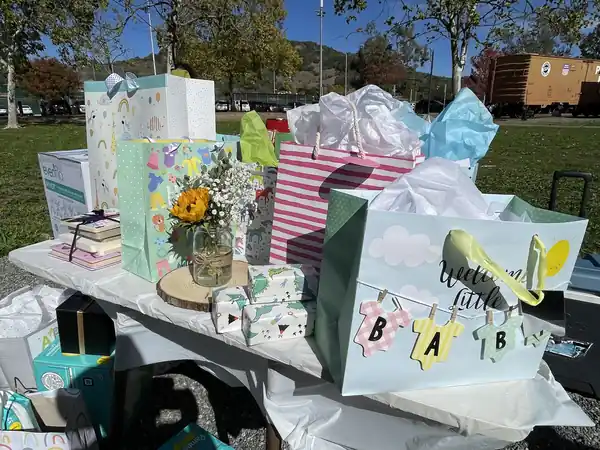
Gifts are the visible part of a shower, and they deserve a prayer of their own — not a long one, and not a formal one, but a moment that turns a pile of presents into something more than shopping. The best time to pray over the gifts is just before the mom starts opening them. Everyone is looking at the table. The wrapping paper is bright. The mom is smiling. A short prayer there says, without lecturing anyone, that these gifts are not just things. They are love, made practical, for a baby who will need every single one of them.
Here is a prayer you can read over the gifts, standing by the table, in about thirty seconds. Read it slowly, and look at the gifts as you read it, not only at your paper. That small gesture — looking at the tiny clothes, the blankets, the books — makes the prayer feel real instead of abstract, and it helps the room see the gifts through the prayer rather than past it.
Thank You, God, for every gift on this table, and for every person who chose it with love. Bless these tiny clothes, these blankets, these books, and all the practical things that will make a new mom’s days a little easier. May each gift be used with joy, may nothing be wasted, and may this baby grow up knowing that before they ever arrived, a whole room full of people was already providing for them. Bless the givers too — return their kindness to them, and remind them that their generosity matters. Amen.
That prayer does three quiet things. First, it thanks God for the gifts without making the gifts the point. Second, it names the ordinary things — clothes, blankets, books — because ordinary things are what a new baby actually lives in, and naming them makes the prayer honest. Third, it blesses the givers, which matters, because the people who brought gifts sometimes feel invisible once the wrapping paper starts flying. A prayer that notices them, even briefly, tells them they were part of the welcome too.
If the gifts include something handmade — a knitted blanket, a sewn quilt, a wooden toy made by a grandfather — name it if you can, and name the person who made it. “Thank You for this blanket, made stitch by stitch by Grandma” is a sentence that will make a grandmother cry in the best way, and it costs you nothing to add. If money is tight for some guests, and you know it, do not make the prayer about expensive gifts. Keep it about love and provision, not price. A prayer over the gifts should make every giver feel included, whether they brought a handmade hat or a pack of diapers from the supermarket. Both are love. Both count.
A Prayer for the Mom
The mom is the center of the shower, and she is also the person most likely to be tired, overwhelmed, and quietly wondering if she is doing any of this right. She has spent months carrying a baby, answering the same questions, and hearing advice she did not ask for. A prayer for her should not add to the noise. It should be the one moment in the day when somebody speaks directly to God about her — not about the baby, not about the nursery, not about the birth plan, but about her. Her body, her heart, her fears, and her hopes. That is why this section is separate from the main prayer, even though the main prayer already prays for her. Sometimes a mom needs to hear her own name in a prayer twice.
God, thank You for [mom’s name]. You know her — the real her, not just the glowing mom-to-be everyone sees today. You know the nights she lay awake wondering, the days her back ached and her feet swelled, the moments she felt strong and the moments she felt afraid. Thank You for carrying her through each one. Now, as the birth draws closer, give her deep rest, real sleep, and mornings when she wakes up feeling a little more like herself. Give her courage for labor, wisdom for the decisions she will have to make quickly, and a birth team who listens to her and treats her with kindness. Give her grace for the days after the birth, when the visitors go home and the nights get long — grace to ask for help, grace to accept it, and grace to be imperfect without feeling like a failure. Remind her, every day, that she is already a good mom, because she is already loving this baby with her whole heart. Amen.
Read that prayer slowly, and mean the line about grace. New moms hear a lot about being natural, being ready, and bouncing back. They hear very little about grace. A prayer that gives a mom permission to ask for help, to accept it, and to be imperfect is a prayer that will stay with her long after the shower balloons have deflated. It is also a prayer that tells the room something important: the mom’s job after today is not to be perfect. It is to be loved, supported, and allowed to learn.
If you are the mom’s own mother, or her sister, or her best friend, you can add one personal line to this prayer, in your own words, after the “Amen” is not the place — add it before the closing, so it stays inside the prayer. Something like, “And thank You for the way she has already loved this baby, even on the hardest days.” Or, “Thank You for letting me watch her become a mom.” One personal line, spoken in your own voice, turns a written prayer into a witness. The room will hear that you are not just reading. You are speaking from a life you have actually watched.
One caution, and it matters: do not use this prayer to give advice. Do not slip in a line about breastfeeding, or sleep training, or how she should give birth. A prayer is not a lecture with “Amen” at the end. If you have advice, give it another day, privately, and only if she asks. Today, pray for her strength, her rest, and her peace, and leave the decisions to her and to God. That restraint is itself a form of love, and a mom who feels prayed for rather than instructed will trust you more, not less, in the months to come.
A Prayer for the Dad or Partner
At many showers, the dad or partner is not even in the room. Sometimes he is at work. Sometimes the shower is a women-only tradition in that family. Sometimes he is there, standing at the edge of the room with a plate of cake, unsure where he fits. Whatever your shower looks like, the dad or partner deserves a prayer too, and this is the gap almost every baby shower prayer list misses. Competitors write twenty prayers for the mom and the baby, and none for the man or partner who is about to become a father, who is also nervous, also tired, and also wondering if he will be enough. Praying for him, by name, in front of the people who love this family, tells him he is not an afterthought. He is part of this story from the beginning.
God, thank You for [partner’s name], the baby’s dad. Thank You for his love for [mom’s name], for the way he has shown up through this pregnancy — in the middle-of-the-night trips, the appointments, the listening, and the quiet worrying he does not always say out loud. Give him steady hands and a steady heart for what is coming. Help him to be present in the birth, even when he feels helpless. Help him to listen before he fixes, to stay when it is hard, and to love this baby with patience on the nights when nobody is sleeping. Give him good friends to talk to, and the freedom to say when he is scared or tired without feeling like he has failed. Make him the kind of dad this child will run to, and the kind of partner [mom’s name] can lean on. Bless his work, his rest, and his heart. Amen.
If the dad is in the room, look at him when you read the line about steady hands. If he is not in the room, say his name anyway, clearly, so the mom hears it and the room hears it. A name spoken in prayer when the person is absent still counts, and it often means more, because it says, “We did not forget him just because he is not here.” If the partner is not the baby’s father, or if the family shape is different — two moms, a single mom, a grandparent stepping in — change the words to fit the real family in front of you. The prayer is not about a label. It is about the person who will be there at two in the morning, holding the baby, and who also needs God’s help to do it well.
Do not make the dad’s prayer a joke. It is tempting, in a joyful room, to add a line about diapers or about him finally learning to change one. A little humor has its place at a shower, but not inside a prayer for a new father. He is about to take on one of the biggest responsibilities of his life, and a prayer that treats him seriously tells him you believe he can do it. Save the jokes for the games. Let the prayer be the moment when the room says, without laughing, “We are praying for you, we believe in you, and we are here for you too.”
If the dad is a new believer, or not a believer at all, this prayer still works, because it speaks about him with respect and hope, not with pressure. You are not preaching at him. You are thanking God for him, in front of the people who love him. That is a gentle witness, and it leaves the door open without pushing anyone through it. And if you are the dad yourself, and you are the one reading this prayer — which happens more often than people think at co-ed showers — read it in the third person anyway, or change it to “me” if that feels more honest. A dad who prays for himself, out loud, in front of his family, is not being awkward. He is being brave, and his child will one day be glad he was.
A Prayer for the Baby
The baby is the reason everyone is in the room, and yet the baby is the person nobody has met. That is a strange and beautiful thing about a shower. You are celebrating someone you have not yet held, whose laugh you have not yet heard, whose personality you can only guess at from a scan photo on a fridge. A prayer for the baby should honor that mystery without pretending to know the future. It should ask God for health and safety, for a joyful welcome, and for a life that grows into love — and it should do so without making promises about what that life will look like. No prayer can guarantee a baby’s future. A good prayer can place that future, gently, in God’s hands.
Heavenly Father, we pray for this little one, who is already so loved and not yet here. You formed this baby, You knit this baby together, and You know every detail we are still waiting to discover. Keep this baby safe. Give health, growth, and strength. Give a safe birth, a peaceful first night, and a home full of warmth. May this child grow up knowing they are wanted, knowing they are loved, and knowing they are never alone. Give them curiosity, kindness, and courage. Give them laughter that comes easily, and comfort that comes quickly when they cry. Protect their little body, guard their little heart, and surround them with people who will tell them the truth kindly and show them what love looks like. One day, may this child know You for themselves — not just as a name in a prayer at a shower, but as a God who has loved them from before they were born. Amen.
There is a verse that belongs with this prayer, and it is worth reading slowly, either before the prayer or after it. “For you formed my inmost being. You knit me together in my mother’s womb. I will give thanks to you, for I am fearfully and wonderfully made. Your works are wonderful. My soul knows that very well.” — Psalm 139:13-14 (WEB). Read it in full at BibleGateway, Psalm 139:13-14 (WEB). That verse is the reason this prayer can be both joyful and calm. The baby is not an accident, not a worry, not a project to manage. The baby is fearfully and wonderfully made — made on purpose, by a God who already knows them. When you read that verse at a shower, you are not just decorating the prayer with Scripture. You are giving the room a reason for the joy they already feel.
If the parents have shared the baby’s name, use it in this prayer, and use it more than once. A name spoken in prayer makes the baby feel real in a way that “the baby” never quite does. If they have not shared a name, or if they are waiting until the birth to choose one, use “this little one” and “this precious baby” instead, and do not ask them, in the middle of the prayer or just after it, what the name will be. They will tell the room when they are ready. A prayer is not the moment to press for an announcement. It is the moment to love a child whose name you do not yet know, and to trust that God knows it already.
Keep this prayer hopeful, even if the pregnancy has been worrying — and the next section will say more about that. For a straightforward, healthy pregnancy, hope is easy. Let it be easy. Do not add worry to a joyful prayer just to sound serious. Joy is serious too. A baby shower is a celebration, and a prayer for the baby that is full of joy, gratitude, and hope is exactly right for the day. Save the heavier prayers for the private moments, or for the section below, where they belong and where they will be heard with the care they deserve.

When the Pregnancy Has Been Hard
Not every pregnancy that ends in a shower has been easy, and a prayer that pretends it was can feel like a door closing in a mom’s face. Some moms in that room have lived through loss — a miscarriage, a stillbirth, a baby they held for only a short time. Some have come through IVF, through years of waiting, through injections and appointments and hope that kept breaking and being rebuilt. Some are carrying a high-risk pregnancy, seeing a specialist every week, counting days between scans, and trying to celebrate while also being afraid. Some are anxious in a way they cannot quite explain, even when the doctors say everything looks fine. If that is the mom you are praying for, the main prayer above is still a good place to start, but it needs a gentler, more honest companion. This section is that companion, and it is the section almost no baby shower prayer list bothers to write.
Here is a prayer for a hard pregnancy, written to be read slowly, in a calm voice, without rushing past the difficult lines. Do not read it loudly. Do not read it cheerfully. Read it as if you are sitting beside the mom, holding her hand, and telling God the truth on her behalf. If you are not sure whether this prayer fits your shower, ask the mom privately beforehand. A simple “Would you like me to mention the hard road in the prayer, or keep it light today?” gives her the choice, and her choice is the right one. Some moms want the hard road named, because being seen matters more than being cheerful. Some moms want one afternoon where nobody mentions it, because they have lived with it every day for months. Both are valid. Ask, and then honor what she says.
God, we thank You for this baby, and we thank You for [mom’s name], who has walked a harder road than most people in this room will ever know. You have seen the waiting, the loss, the treatments, the worry, and the nights when hope felt far away. Thank You for bringing her to this day. We pray for her heart now — for peace that is not pretend, for rest that is real, and for the freedom to feel joy and fear at the same time without feeling guilty about either. Give her strength for the weeks ahead, wisdom for her doctors, and people around her who will listen without trying to fix what cannot be fixed with a sentence. Keep this baby safe, Lord. We ask for health, for growth, for a safe birth, and for a welcome full of love. And if there are days ahead that are hard, give this family the help they need, when they need it, from people who will simply show up. Hold this mom, hold this dad, and hold this precious baby in Your hands. Amen.
Notice what that prayer does not do. It does not say “everything happens for a reason”. It does not say “at least you have this baby now”, as if a new baby erases a loss. It does not promise a perfect outcome, because nobody in that room can promise that, and a mom who has lived through loss knows it. What it does is name the road, thank God for bringing her this far, and ask for peace, strength, and help — the three things she actually needs, in language she can receive without flinching. That is why the line about feeling joy and fear at the same time matters so much. Many moms after loss, or after IVF, feel guilty for being afraid on a happy day, and guilty for being happy when they are still grieving. A prayer that says both feelings are allowed gives her permission to be whole, not just cheerful.
There are also things not to say, and they matter as much as the prayer itself. Do not mention the loss in detail, in public, unless the mom has asked you to. Do not name a baby who was lost, unless the family has named that baby publicly and wants that name spoken. Do not tell the room the medical details of the pregnancy, even if you know them. Do not say “God must have a plan” as if that settles the grief. And do not, in the same breath as the prayer, tell the mom to relax, or to stop worrying, or to just enjoy it. She is trying. Your job in the prayer is not to fix her feelings. It is to carry them to God with her, for one quiet minute, and then to hand her back to a room that loves her.
After the shower, the hard-pregnancy prayer keeps working in a private way. If you are close to the mom, check in the next week, and the week after that, without needing a reason. A text that says “Thinking of you and the baby today, no need to reply” is a small thing that can mean a great deal to a mom who is still anxious. Offer practical help, not just words — a lift to an appointment, a meal in the freezer, an hour of sitting with her while she rests. The prayer at the shower is the beginning of that care, not the whole of it. A mom who has walked a hard road will remember who prayed honestly, and who kept showing up after the balloons were gone.
The Guests’ Role in the Prayer
A baby shower prayer is not a performance with an audience. It is a moment when a whole room prays together, even if only one person is speaking out loud. That is a different thing from a speech, and it changes what the guests are supposed to do. If you are a guest, your role is simple, and it is more important than you think. When the reader says, “I’d like to pray now”, put your phone down. Not face down on your lap, where you can still glance at it, but down, away, in your bag or on the table. Close your eyes if you are comfortable, or bow your head, or simply look towards the mom. Listen. That is the whole job. Listening, fully, without checking the time or whispering to the person next to you, is a form of prayer in itself. It tells the mom that her life, and her baby’s life, are worth a minute of everyone’s undivided attention.
If you are comfortable, say “Amen” at the end, out loud, with the room. Not loudly, not performatively, just clearly enough that the reader hears it and knows they were not praying alone. A room that says “Amen” together sounds like agreement, and agreement is comforting. It tells the mom that the prayer was not just one friend’s nice words. It was a room full of people, saying together, “Yes, God, we ask this too.” If you are not comfortable saying “Amen” — because you are not sure what you believe, or because you are from a different tradition — you do not need to say it. A quiet nod, a smile at the mom, a hand on her shoulder afterwards, says the same thing in a different language. Nobody at a shower should be made to feel like an outsider for praying differently, or for not praying at all.
Guests can also pray without words, in the weeks after the shower. That is the part of the guests’ role that nobody talks about, and it is the part that matters most. Pray for the mom in your own time, in your own way, on an ordinary Tuesday when there are no balloons and no cake. Pray for a safe birth. Pray for sleep. Pray for the dad, too. And then, because prayer and practical help belong together, do something small and concrete. Bring a meal. Offer to hold the baby while the mom showers. Send a text that does not need a reply. The prayer at the shower is a promise, in a way, that the room will keep caring after the party ends. Guests who keep that promise, quietly and without fuss, are the reason showers matter at all.
If you are a guest who has been asked to read a second prayer, or to lead a short moment of prayer over the gifts, talk to the main reader first. Agree who is praying when, and keep your prayer short — thirty seconds is enough. Two long prayers back to back will lose the room, however beautiful the words are. One long prayer and one short one, in different parts of the shower, works far better. And if you are a guest who disagrees with something in the prayer — a line about God, a verse, a way of speaking about the baby — do not correct it in the moment. Let the prayer belong to the mom and the reader. You can have a kind conversation later, privately, if it matters to you. In the moment, the kindest thing is to listen with grace, and to let the mom receive the blessing without interruption.
What Not to Say at a Baby Shower Prayer
A prayer can be ruined by one careless line, and the lines that ruin it are rarely meant unkindly. They are usually meant to be funny, or reassuring, or impressive, and they land badly anyway. So here is a short list of what to leave out, learned from showers where the prayer went wrong and the room felt it. Do not make a joke about the mom’s size, her appetite, her mood, or her body. Pregnancy jokes are almost never as funny as the person telling them thinks, and they are never funny inside a prayer. Do not comment on the baby’s sex, or on whether the parents “wanted” a boy or a girl, unless the parents have already celebrated it themselves. Do not use the prayer to announce news the parents have not announced — a name, a due date change, a medical detail. A prayer is not a press release.
Do not use the prayer to preach a sermon. A baby shower is not a church service, even if it is held in a church hall. One verse, read slowly, is enough. A five-minute teaching on a passage will lose the room, and it will make the mom feel like the prayer was about the reader’s knowledge rather than about her and her baby. Do not name people who are not there in a way that embarrasses anyone — an absent father, a strained family relationship, a guest who could not come. Pray for the family as it is, with love, without drawing attention to who is missing or why. And do not end the prayer with a request for the mom to do something, like “and help her to be a better mom” or “help her to stop worrying”. A prayer that ends with a criticism, however gentle, is not a blessing. End with gratitude, with hope, and with “Amen”. Let the last thing the mom hears be love.
Finally, do not apologize for the prayer. Do not start with “I’m not very good at this” or end with “Sorry, that was a bit long”. An apology before a prayer tells the room to lower their expectations, and an apology after it tells the mom the prayer was a burden. You were asked to pray because someone trusts you. Trust that, and trust the words. Read them slowly, read them sincerely, and then stop. The prayer does not need your apology to be valid. It needs your honesty, and you have already given that by standing up and reading it.
More Blessings for the People You Love
A baby shower is one of those days when a short, honest blessing does work that a long speech cannot, and the same is true on many other days in a family’s life. If you are building a habit of marking people’s milestones with prayer, you will find more in our Blessings collection on HolyPrayerz — including a new baby blessing for the day this little one actually arrives, a short birthday prayer for a friend for the many birthdays ahead, and a wedding blessing for the next happy couple you celebrate. Each one is written to be copied, sent, or read aloud, in the same spirit as this baby shower prayer: simple, Bible-based, and meant to be shared.
Frequently Asked Questions
How long should a baby shower prayer be?
About one to two minutes is ideal for a baby shower prayer read aloud. The main prayer on this page takes roughly ninety seconds when read slowly, which is long enough to feel meaningful and short enough that the room stays with you. A prayer that runs past three minutes will lose people, however beautiful the words are, especially if the mom is tired or the room is warm. If you are unsure, use the short card version instead. A short prayer read calmly is always better than a long prayer read in a rush.
When should I read the baby shower prayer?
Read it after the first food and hellos, and before the gifts begin, when everyone has arrived and the room has settled. That gives the prayer its own clear space and makes it the heart of the shower rather than an interruption. Do not read it in the first five minutes, when people are still arriving, and do not leave it until the very end, when people are thinking about leaving. Tell the mom in advance that you would like to pray, so she is not caught off guard.
Can I read this baby shower prayer if I am not the host?
Yes. The host, a best friend, a sister, a mom, or a grandmother can all read it well. What matters is not your title, but that you love the mom and are willing to read slowly and sincerely. Check with the host first, so you do not both stand up to pray at the same moment, and agree who is praying when. One prayer, read well, is better than two prayers competing for the same moment.
What if the mom-to-be is not very religious?
This baby shower prayer still works, because it speaks as a friend who prays, without assuming the mom uses the same language every day. It does not lecture, and it does not demand agreement. If you know the mom well, she will hear your voice in it first and the theology second. Keep it warm, keep it short if she prefers, and do not add a sermon around it. A gentle, honest prayer is a gift, not a test.
Should I include the baby’s name in the prayer?
Yes, if the parents have shared it publicly. A name spoken in prayer makes the baby feel real and loved. If they have not shared a name yet, or if they are waiting until the birth, say “this little one” or “this precious baby” instead, and do not press them for the name during or just after the prayer. They will share it when they are ready, and the prayer is just as meaningful without it.
What should I pray if the pregnancy has been difficult?
Use the prayer in the “When the Pregnancy Has Been Hard” section, and ask the mom privately beforehand whether she would like the hard road named or kept light on the day. Name the waiting, the loss, or the worry gently, without details, and pray for peace, strength, and help. Do not say “everything happens for a reason”, do not promise a perfect outcome, and do not tell her to relax. A prayer that tells the truth kindly is far more comforting than one that pretends the road was easy.
Can the dad or partner be included in the prayer?
Yes, and he should be. The main prayer on this page includes the dad or partner by name, and there is a separate prayer for him as well. If he is in the room, look at him for that part. If he is not there, say his name anyway, so the mom and the room hear that he was not forgotten. Change the words to fit the real family — two moms, a single mom, or a grandparent stepping in — because the prayer is about the person who will be there at two in the morning, not about a label.
Is it okay to cry while reading the prayer?
Yes. A voice that wobbles, or eyes that fill up, will not ruin the prayer. In a room full of people who love this baby, tears sound like honesty. Do not stop to apologize, and do not rush to finish because you are embarrassed. Pause, breathe, and keep going. The mom will remember that you cared enough to be moved, not that your voice shook on one line.
However you read it — in a living room, a church hall, or a garden full of balloons — may this baby shower prayer do what a good prayer is meant to do: slow the room down, thank God for a life that is already loved, and send the mom, the dad, and the baby into the days ahead knowing they are not facing them alone.

The HolyPrayerz Editorial Team shares short, sendable blessings for occasions, relationships, and holidays — Bible-based words you can copy, text, or share in a moment.